Case Study: Safe Online Practices & Cyber Crime Trends (Cyber Cell, L.B. Nagar)
Overview
This case study documents a one-day field project conducted at the Cyber Cell Police Station, L.B. Nagar (Rachakonda Police Commissionerate) as part of the B.Tech (CSE – Cyber Security) curriculum at the Institute of Aeronautical Engineering.
The objective was to gain first-hand exposure to real cybercrime investigations, understand emerging attack patterns, and study how law enforcement responds to digital threats affecting individuals and organizations.
Context & Scope
- Location: Cyber Cell Police Station, L.B. Nagar, Hyderabad
- Duration: One-day field engagement
- Focus Areas:
- Common cybercrime complaints
- Investigation workflows
- Cybercrime reporting mechanisms
- Preventive cybersecurity practices
This study was observational and analytical, based on direct interaction with cybercrime investigators and real-world cases handled by the Cyber Cell.
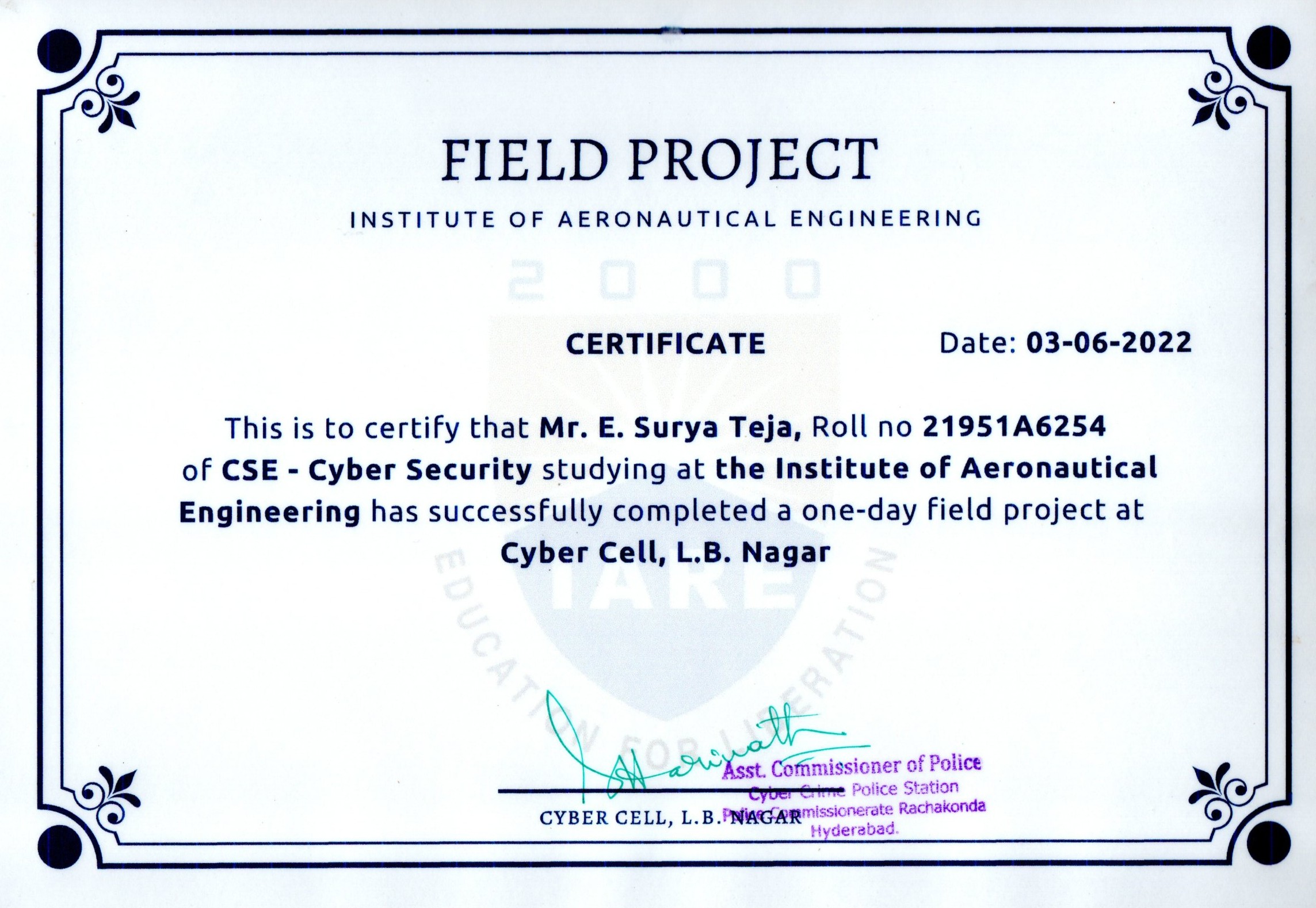
Appendix: Questionnaire (PDF)
The following questionnaire was used during interactions with Cyber Cell officials and serves as primary supporting evidence for this case study.
📄 Download: Cyber Cell Field Project Questionnaire (PDF)
Methodology
The case study was conducted using:
- Direct interaction with Cyber Crime Police Officers
- Analysis of reported cybercrime cases
- Review of complaint handling and investigation workflows
- Documentation of attack patterns and preventive strategies
Key Cybercrime Trends Observed
During the engagement, the following trends were consistently observed:
- Financial Cybercrimes
- Phishing attacks
- Instant loan application fraud
- Fake investment schemes
- Social Media Crimes
- Account impersonation
- Online harassment
- Identity theft
- Emerging Threats
- Malware-based data exfiltration
- Social engineering–driven fraud
- Abuse of excessive mobile application permissions
A significant rise in cybercrime incidents was noted, highlighting the need for increased user awareness and faster incident reporting.
Case Study: Scheduled Loan Fraud
Attack Scenario
A victim received a loan offer through a third-party mobile application promoted via caller-identification platforms. Upon installation, the application requested excessive permissions, including access to contacts, media files, and messages.
After issuing a small loan amount, attackers extracted sensitive data and initiated blackmail by threatening to leak personal information unless a ransom was paid.
Attacker Methodology
- Social engineering through fraudulent loan advertisements
- Malicious application permissions abuse
- Extraction of personal and social data
- Extortion through psychological pressure and threats
Impact on Victims
- Financial loss
- Psychological distress
- Privacy invasion
- Loss of trust in digital platforms
This case demonstrates how non-technical users are often targeted through psychological manipulation rather than advanced technical exploits.
Investigation & Law Enforcement Response
The Cyber Cell follows a structured investigation process:
- Complaint Registration
- National Cybercrime Helpline: 1930
- Online Portal: https://cybercrime.gov.in
- Preliminary Assessment
- Classification under relevant cyber laws
- Digital Forensics
- IP tracing
- Transaction analysis
- Device inspection
- Legal Action
- IT Act, 2000
- Relevant IPC sections (e.g., Section 420)
Preventive Measures & Best Practices
Based on observations and officer recommendations:
- Avoid installing applications from unverified sources
- Review and limit mobile application permissions
- Enable multi-factor authentication wherever possible
- Keep operating systems and applications updated
- Preserve digital evidence immediately after an incident
- Report cyber incidents promptly through official channels
Key Learnings
- Cybercrime investigations require both technical expertise and legal awareness
- Many cyber incidents succeed due to lack of user awareness
- Early reporting significantly improves investigation and recovery outcomes
- Cybersecurity challenges are often human-centric rather than purely technical
Conclusion
This field project provided valuable exposure to real-world cybercrime scenarios and investigation workflows. Understanding attacker behavior, victim impact, and law enforcement procedures reinforced the importance of cyber awareness, digital hygiene, and timely incident response.
The experience strengthened interest in offensive and defensive cybersecurity, particularly in bridging the gap between technical security controls and real-world crime prevention.